
Essay 5
The Weight of Responsibility
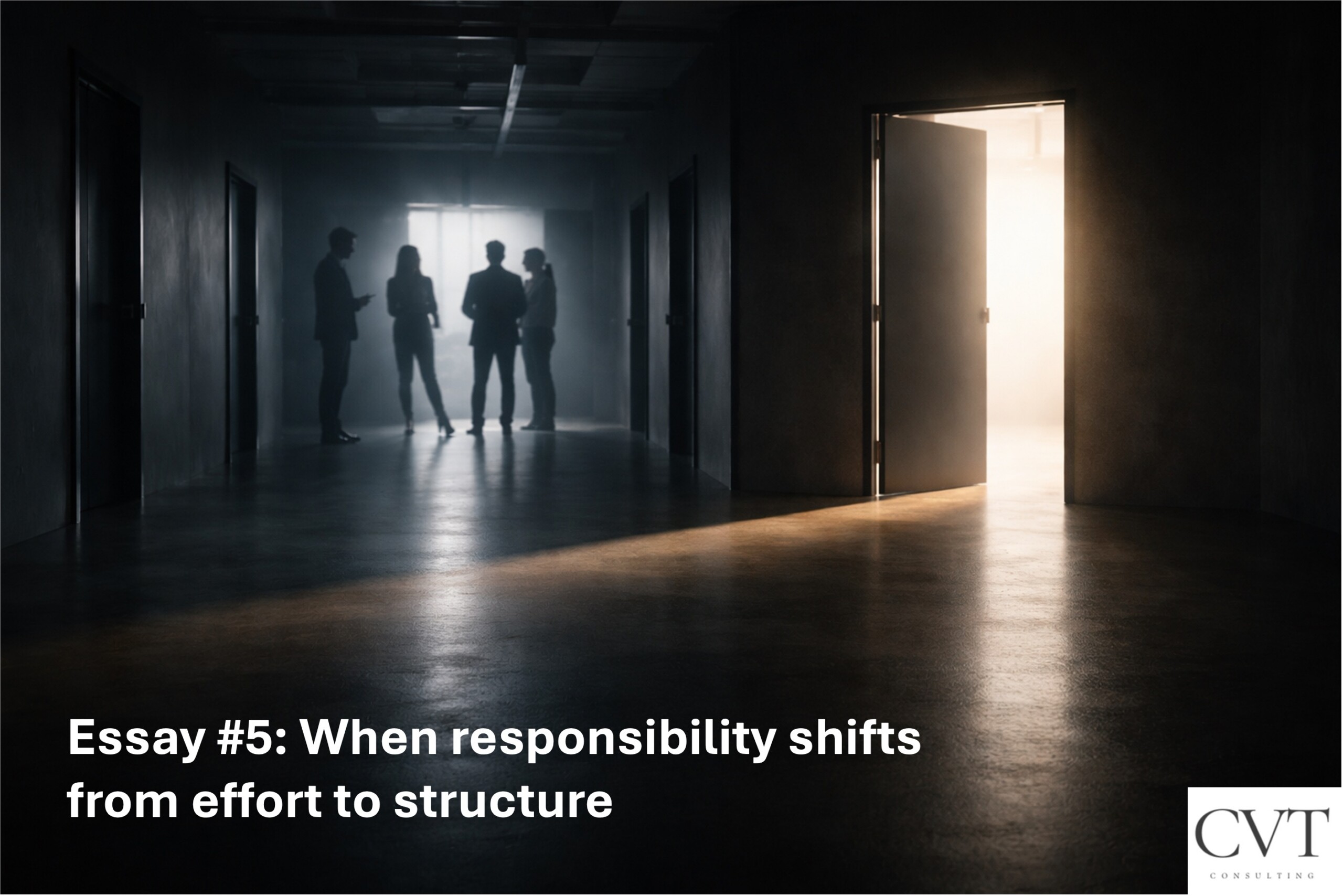
When responsibility shifts from effort to structure
If leadership is an architecture, responsibility is one of its load-bearing elements. It determines how tension is absorbed, where pressure accumulates, and whether a system can sustain complexity over time. Yet in most leadership conversations, responsibility is treated as a moral or psychological category rather than a structural one. It is described in terms of accountability, ownership, courage or resilience. Rarely is it examined as a design variable.
In early leadership roles, responsibility appears manageable because its boundaries are clear. A team must deliver a result. A process must improve. A conflict must be resolved. The leader intervenes, decides, corrects and produces visible outcomes. The connection between effort and impact is tangible enough to reinforce a sense of competence. Responsibility, though demanding, remains proportionate. It can be intensified through work.
As leaders move into broader roles, the nature of responsibility shifts in ways that are difficult to articulate. The leader’s actions no longer affect only tasks; they influence interpretive climates. A decision signals what is valued. A silence suggests what is tolerated. A structural change alters incentives long after the original intention has faded. Responsibility expands beyond operational execution and becomes systemic. The leader shapes not only outcomes, but the conditions under which outcomes are generated.
Many leaders experience this expansion primarily as weight. They feel more exposed to risk, more accountable for failures, more obligated to ensure coherence across increasingly complex domains. The intuitive response is often to increase effort. They involve themselves more deeply in decisions, maintain tighter oversight or accelerate clarification processes in order to reduce uncertainty. These behaviors are not arbitrary; they are extensions of patterns that once secured effectiveness. What previously worked under conditions of limited scope is now applied under conditions of systemic interdependence.
At this point, the earlier theme of unbewusste Unwirksamkeit acquires a new layer. Responsibility is interpreted through biographical success patterns. A leader who advanced through technical mastery may equate responsibility with being the most informed voice in critical discussions. A leader whose credibility rested on reliability may associate responsibility with proximity to every relevant issue. A leader who gained trust through relational containment may experience responsibility as the obligation to absorb tension personally rather than expose it to collective deliberation. Each of these interpretations carries an internal logic. Each once generated recognition. Yet as organizational complexity increases, these interpretations begin to distort the distribution of responsibility within the system.
The distortion is subtle because it emerges from strength rather than deficiency. The leader does not seek control; they seek coherence. They do not centralize decisions out of distrust; they do so out of commitment. They do not hesitate to delegate because they undervalue others; they hesitate because they equate responsibility with personal assurance. The paradox lies in the structural consequences. The more responsibility is experienced as personal burden, the more dependent the system becomes on the leader’s presence. Initiative narrows. Escalation increases. Decision pathways shorten around a central figure. What feels internally like dedication gradually generates external fragility.
To understand this shift more precisely, it is helpful to differentiate between layers of responsibility that are often conflated. There is responsibility for direction — the obligation to articulate strategic orientation and define boundaries. There is responsibility for decision — the authority to determine a course of action under uncertainty. There is responsibility for execution — the operational ownership of implementing specific tasks. And there is responsibility for coherence — the long-term safeguarding of structural and cultural alignment. In early roles, these layers frequently overlap in a single individual. In more complex systems, they must be distinguished deliberately. When they remain fused, leaders compensate through effort. When they are clarified, responsibility becomes distributable without dissolving accountability.
The difficulty lies in the emotional dimension of this clarification. Distinguishing responsibility structurally often requires relinquishing forms of involvement that previously affirmed identity. A leader who built self-confidence through rapid problem-solving may experience the shift toward architectural responsibility as passivity. A leader who defined themselves through operational excellence may interpret structural distancing as detachment. The system requires differentiation; the self experiences loss. This tension is rarely acknowledged explicitly, yet it shapes how leaders respond to increasing scope.
Another dimension deepens the challenge: temporal responsibility. As leadership expands, the time horizon of consequences extends. Decisions about incentives, communication norms or organizational design reverberate beyond immediate results. Cultural signals unfold gradually. Interpretive habits sediment over years. Responsibility thus becomes less about immediate performance and more about stewardship of trajectories. The leader must consider not only whether a decision solves a present issue, but what pattern it reinforces over time.
Under such conditions, the desire for certainty intensifies. Leaders may seek to stabilize ambiguity by tightening control, accelerating decisions or leaning more heavily on established interpretations. Yet certainty at systemic levels is structurally limited. Complexity cannot be eliminated; it can only be framed. The mature shift in responsibility therefore involves recognizing that leadership at higher levels is less about resolving uncertainty and more about orienting it. Orientation creates shared reference points without prescribing every movement. It defines what matters and what does not, without exhausting the system through constant intervention.
At this stage, responsibility and feedback become inseparable. As systemic influence increases, informational asymmetry widens. Signals reaching the leader are filtered through hierarchy, expectation and caution. Dissent becomes selective. Agreement appears smoother than it is. Without deliberately constructed feedback structures, responsibility risks consolidating into self-reinforcing interpretation. The leader continues to act in good faith, unaware that their structural position has reduced corrective friction. What once functioned as conviction becomes rigidity.
Designing responsibility structurally therefore entails designing feedback structurally. It requires more than rhetorical openness. It requires credible spaces in which interpretations can be challenged without personal consequence. It demands routines in which alternative readings of reality are invited deliberately rather than tolerated occasionally. Such structures protect not only the organization but also the leader from the isolating effects of expanded scope. Responsibility that is not exposed to contradiction gradually loses calibration.
There is also a cultural dimension to structural responsibility. Leaders do not merely allocate tasks; they signal norms. When responsibility is consistently centralized, even unintentionally, cultural expectations adjust accordingly. Teams learn that escalation is safer than judgment. They learn that final clarity resides above rather than within their own interpretive capacity. Over time, this reshapes initiative. Responsibility, though formally delegated, remains psychologically retained. Conversely, when leaders clarify boundaries, define decision rights explicitly and resist the impulse to reclaim ownership under pressure, they cultivate distributed agency. Responsibility becomes embedded in the architecture rather than attached to personality.
This is the moment at which leadership matures. Responsibility ceases to be measured by personal strain and begins to be evaluated by systemic resilience. The question is no longer how much the leader carries, but how well the system holds without them. Intervention becomes more selective. Silence becomes more deliberate. Clarification replaces control. The leader’s authority does not diminish; it stabilizes through structure rather than intensity.
Seen architecturally, responsibility is not the pinnacle of leadership but its underlying geometry. It determines where authority resides, how interpretation flows and how future consequences accumulate. When responsibility remains personal, leadership becomes heroic but fragile. When responsibility becomes structural, leadership becomes sustainable. The shift from effort to structure does not lighten the weight of responsibility; it redistributes it. And in that redistribution lies the difference between influence that depends on presence and influence that endures beyond it.
CT
